


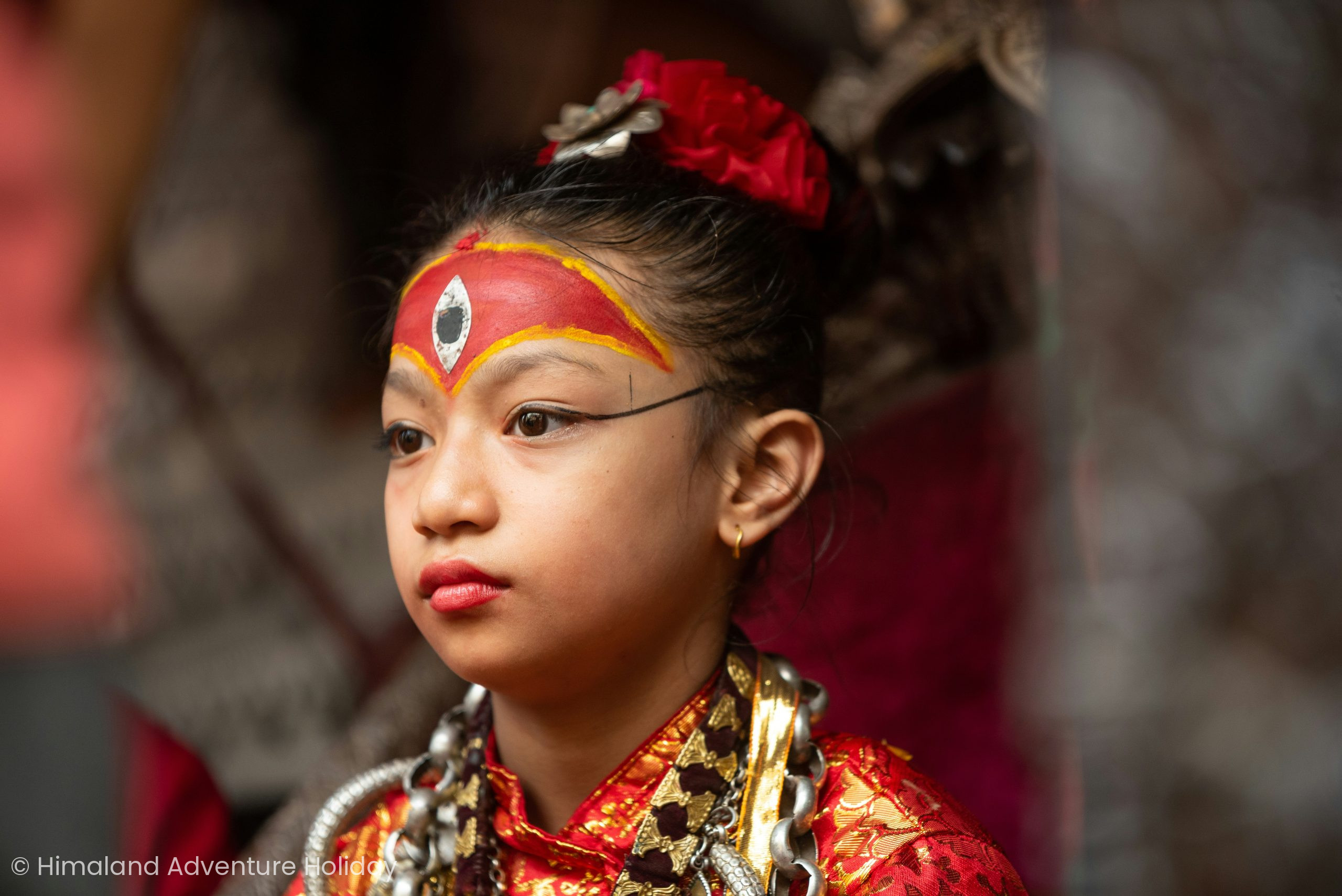
In the streets of Kathmandu lives a child who serves as a living goddess. People know her as the Kumari and regard her as the living incarnation of the goddess Taleju. A strict traditional process selects her for this role. She then leaves her family home and moves into the Kumari Ghar, the “House of the Kumari.” There, devotees worship her and seek her blessings. Despite her divine status, she remains a young child. She lives within a structured and symbolic tradition that blends Hindu and Buddhist beliefs in Nepal.
How Does One Become the Kumari?
Becoming a Kumari isn’t random, it’s a systematic selection which has been going on for about 300 years with the core traditions not seeing much change. The selection begins in Newar communities of Kathmandu where eligible girls are identified from a very young age, usually between 3-7 years old, before undergoing evaluations to see if she is suitable to become the Kumari. These girls are usually exclusively selected from the Buddhist Shakya families of Kathmandu. Even though the family the Kumari comes from is Buddhist she is worshiped by both the Hindu and Buddhist people of Nepal.
After the selection of girls the process is moved into a series of checks done by priests and elders. The girl is examined for any physical traits which the Kumari needs to possess, such as flawless clear skin and an absence of scars on her body. She should also have good teeth, hair and eyes. Alongside this, they also check her horoscope to see if it is suited to the required spiritual conditions. They also check for her behaviour and temperament, a Kumari must be calm and fearless which is said to be the qualities of a goddess.
What Does the Kumari Do?
Being a Kumari isn’t just a title, being a Kumari means holding an important role in the public and religious life of Nepal where she is worshiped during the major festivals and ceremonies. People also consider her to bring blessings and protection to the land. She is especially significant during ‘Indra Jatra’ where she is carried in a chariot-like wooden carriage throughout the stress of Kathmandu where she is worshiped as devotees come to receive her blessings. During these festivals she is revered and presented as a symbol of purity and divine power.
Even the dignitaries of Nepal come to visit her like the former Hindu Kings of Nepal, the president of the country and also the prime minister of the country come to seek her blessings during the festivals.
The Kumari’s role doesn’t continue on for life, her time as a living goddess usually ends when she reaches puberty or has her first menstruation. This is because it is seen as the end of her divine purity. It could also end early if she bleeds due to an injury. Once her time as a Kumari ends she goes back to her family and lives a normal life.
Outside of these ceremonial occasions her role is mainly symbolic, as she represents the deep connection of Nepal to its religion, traditions and cultural identity.
The Kumari’s Life
Outside her religious duties the Kumari has a very limited childhood life compared to others. Her life is usually staying inside the Kumari Ghar where she studies, plays in a restricted environment and spends time with her caretakers. She isn’t allowed to go to school like other children and contact with other children is very limited. Her life is closely supervised until the end of her role as the Kumari.
Life beyond the Kumari
Although the Kumari is worshiped as the living goddess she is still a young child underneath it all. After selection her entire life is shaped by duty and tradition where she doesn’t get to live a normal life like other children her age. The contrast between the divine status and childhood innocence is one of the most defining aspects of being a Kumari. The role of Kumari can be demanding for a child, yet she is entrusted with great cultural significance. The Kumari tradition isn’t just remarkable just because a child is worshiped as a goddess, but also because of the responsibility and discipline it puts on the child.
After her role ends the transition into a normal life might not be as simple. From being revered as the living goddess to a normal person the switch can be difficult for most. She must adapt to a completely new way of life marking a major shift in both identity and experience.
The Kumari remains one of Nepal’s most unique and deeply rooted practices. It reflects a blend of religion and symbolism that shapes the communities of Nepal and shows how they show belief and devotion. At the same time it also raises important reflections on childhood, identity and the balance of culture and life.