
Himaland Adventure Holiday Pvt. Ltd.
(Nepal local trek/tour/retreat holiday expert over 25+ years)

 Talk to an expert
+977 9841135885
Nepal Travel Info
Nepal as a Travel Destination
Nepal is one of the most beautiful tourist destinations in the world and is getting more and more popular. Geographically – natural beauty & serenity is unparalleled with well protected national parks from the tropical low land to the high Himalaya, the Himalayan grandeur is awe inspiring with highest Mt. Everest and many other + 8000-meter-high mountains. Snow fed rivers cascading down the hills and to the plains of Terai, hill terraced farmland punctuated with vibrant green valleys, colorful villages perched on hill sides make the natural scenery so fascinating that it seems like a beautiful mosaic paint of a renowned artist. Nepal lies in South Asia between China and India.
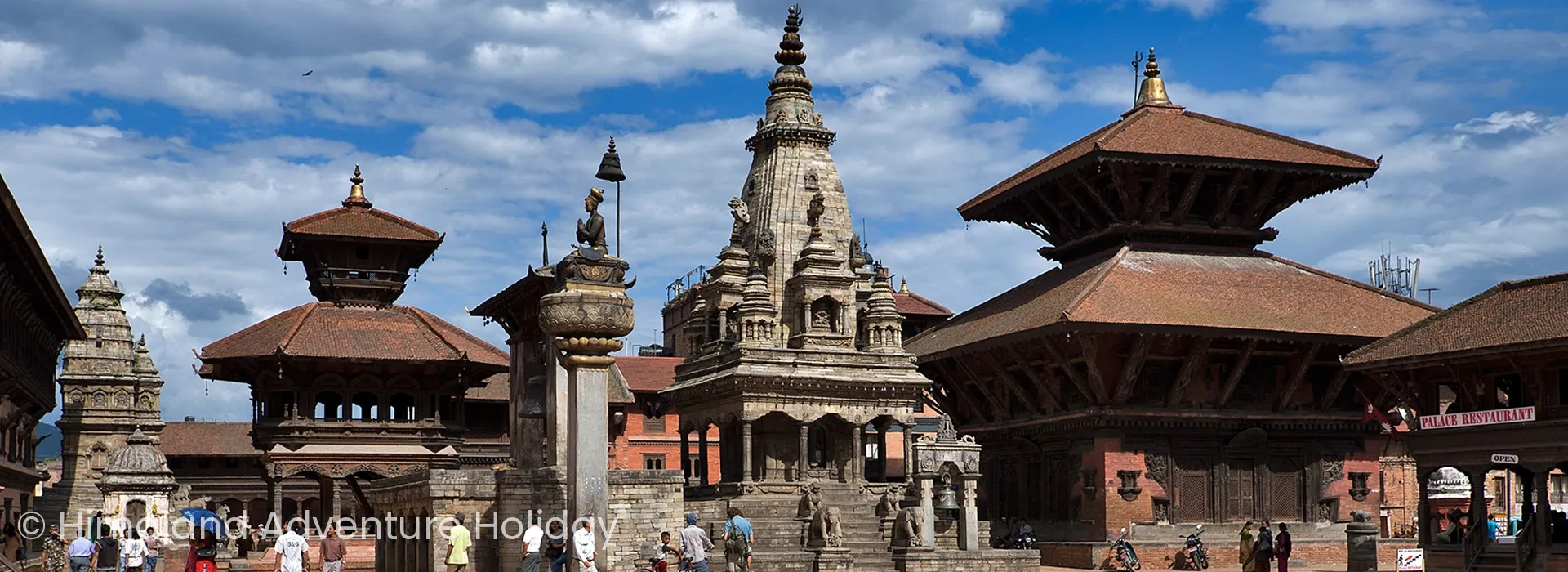
Culturally – Nepal seems to stand still with many ancient & mythical cities and towns like; Kathmandu, Patan, Bhaktapur, Janakpur etc., colorful festivals all around the year, culturally vibrant with age old rich traditions, sacred sites – like Lumbini, birth place of Shakyamuni Gautam Buddha, one of the holiest Hindu temple Pashupatinath and many other temples, monasteries, shrines, palaces listed in UNESCO world heritage sites + sacred places dedicated to different Buddhist Bodhisattvas and deities and also numerous Hindu Gods and Goddesses + saints.
Nepal stands out one of the best in hospitality sectors as ‘respecting guests as Gods; is an inherent culture of Nepali society with very friendly people.
Other superlatives feature of Nepal and Nepal is often listed in Top Travel Destinations, Must Visit Places, Global Destinations etc. by renowned media like;
- BBC Holiday
- Lonely Planet
- Wanderlust Travels
- Modern Maturity Magazine
- Observer Travel Award
- CNN Travele
- Rough Guide
- World Travel Guide
Therefore, Nepal stands out on top as a destination for pleasure, nature and culture holidays specially for wellness retreat, monastic retreat, ashram retreat, spiritual retreat and nature retreat. As a travel destination, Nepal is already a paradise for hiking and trekking, the world center for Himalayan mountaineering and South Asian hub for culture and nature tourism.
Nepal in Facts & Figures
Nepal is a federal republic country with multi-party democratic system of governance and developing in terms of economy. Nepal follows nonaligned foreign policy based on pancha sheel principle, noninterference and mutual respect.
Land mass area of 147,181 sq.km, bordering with India in the East, West and South with the Tibetan Autonomous Region of China in the north. Elevation variation in a short South to North distance, Kanchan Kalan, Jhapa district is the lowest point at 70m above sea level and the summit of Mt. Everest at 8,848 m is the highest. From east to west, Nepal is 800 km long and only 230 km. north to south at its widest.
Within a short distance, Nepal’s topography changes from the alluvial Gangetic plains fertile for agriculture to the barren land of the high snowcapped Himalayan mountains. In the middle lie the mid hills and the lesser mountains consisting of the Churia range and the Mahabharat lek. Temperature in this region is always moderate. There are several inner Himalayan and mid mountain valleys such as; Kaligandaki, Bheri, Naryani, Sunkoshi valleys located at different altitudes ranging from 400 m. to 3600 m.
Upper Himalaya
The Upper Himalaya ranges from 4,000m above sea level to 8,848m above sea level. It occupies 15% of the total area of the country and within this region lie eight of the fourteen highest peaks in the world exceeding 8000m. They are Mount Everest, Kanchenjunga, Lhotse, Makalu, Cho Oyu, Dhaulagiri, Manaslu and Annapurna. The high Himalaya is extremely cold, windy and inhospitable while the region immediately below them are inhabited but the land is far less fertile than the lower Himalayas. These Himalayan mountains and the regions are world famous for trekking and mountaineering.
Middle Hills & Lower Himalaya
The middle hills and Lower Himalaya form the largest part of the country and also has the largest population. Occupying 68% of the country, it enjoys a temperate and nice climate almost all year round. This mid hill land region is far more fertile than in the upper Himalayan region. At the high end, the Mahabharat range reaches an altitude of around 4000m above sea level while the Churia range is lower in comparison. In this region lies the capital, Kathmandu and some of the popular tourist destinations such as Pokhara and Tansen.
Tarai Region
The plains of Nepal are known as the Tarai and they occupy 17% of the land, stretching from the far-west to the far-east covering the entire southern part of the country. With a sub-tropical climate, the land here is very fertile and produces the bulk of the food grains for the country’s population. Along this belt lie the Chitwan National Park, Bardia National Park, Shukla Phanta Wildlife Reserve and the Koshi Tappu Wildlife Reserve which harbor an amazing variety of wildlife including endangered species like royal Bengal tiger, one horned rhino, gharial etc.
Climate – Nepal experiences 4 seasons
- Spring (Mid Feb – April)
- Summer (May – Aug)
- Autumn (Sep – Nov) and
- Winter (Dec – Mid- Feb)
The climate changes rapidly from the sub-tropical Tarai to the cool dry temperate and alpine conditions in the northern Himalayan ranges within a short span of 200 km. In the Tarai, which is the hottest part of the country, summer temperatures rise about 45°C. The climate here is hot and humid in the summer. In the middle hills, the summer climate is pleasant with temperatures around 25°C – 27°C.
The winter temperatures range from 7°C to 23°C in the Tarai and sub-zero to 12°C in the mountainous regions, hills and valleys. The northern Himalayan region has an alpine climate with temperatures reaching below -30°C. The valley of Kathmandu has a pleasant climate with an average summer and winter temperatures of 19°C – 27°C and 2°C – 12°C respectively
Biodiversity
Nepal’s biodiversity is a reflection of its unique geographic position and variations in altitude and climate from 70 meter to the highest in the world 8848 meter, the Mt. Everest. The protected areas add up to 28,585.67 sq km (19.42% of total land cover) of land. There are nine national parks, three wildlife reserves, three conservation areas, one hunting reserve and nine buffer zones. Share of Bio-resources is Amphibians: 1.0%; birds: 9.3%; reptiles: 1.6%; mammals: 4.5%
Access: Land and Air Connectivity
Travelling by air
Nepal Airlines is the national flag carrier of Nepal with flights to/from Delhi, Bombay, Kuala Lumpur, Dubai, Bangkok, Hong Kong, Osaka. Other international airlines operating from/ to Kathmandu are Air Arabia (Sharjah), Air China (Lhasa, Chengdu), ArkeFly(Amsterdam ), Bahrain Air (Bahrain ), Biman Bangladesh (Dhaka), China Southern Airlines (Guanzhou), China Eastern (Kunming), Dragon Air (Hong Kong), Druk Air (Delhi, Paro), Etihad Airways (Abu Dhabi), Fly Dubai (Dubai), GMG Airlines (Dhaka), Gulf Air (Bahrain, Muscat), Air India (Delhi, Kolkotta, Varanasi), Jet Lite (Delhi), Korean Air (Seoul), Pakistan International Airlines (Karachi), Qatar Airways (Doha), Singapore Airlines, Silk Air (Singapore), Thai Airways (Bangkok), Turkish Airlines, (Istanbul).
Traveling by road
All visitors entering Nepal by land must use these designated entry points only:
Nepal – India border
- Kakarbhitta
- Birgunj
- Belhiya, Bhairahawa
- Nepalgunj
- Dhangadi
- Mahendra Nagar
Nepal – China border
- Kodari and Keyrung